Christmas Angel Shadow Box Svg Review
As a designer who constantly bridges the gap between digital files and tangible, stitched goods, I approach every new asset with a healthy dose of skepticism. When I first opened the Christmas Angel Shadow Box Svg, my immediate thought was about translation. This file is marketed primarily as a template for light boxes and paper crafting, recommending white cardstock for optimal results. However, for those of us in the embroidery and mixed-media space, the real question is whether this 3D SVG structure can inform or enhance a textile project. After evaluating the lines, layers, and overall composition, I see significant potential for hybrid creators, but it requires a specific mindset to move from screen to stitch successfully.
First Impressions: Ethereal Lines vs. Stitch Reality
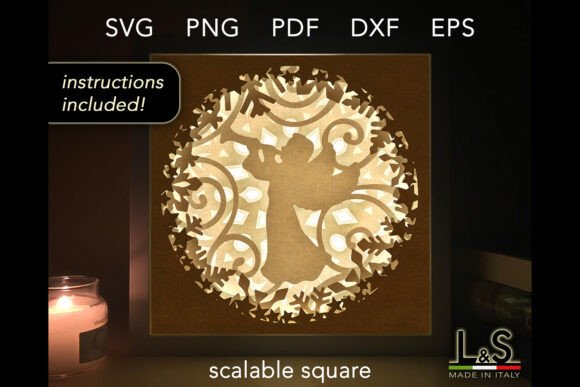
The visual personality of this Christmas Angel Shadow Box Svg is undeniably delicate. It relies on the interplay of positive and negative space to create depth, which is exactly what makes it successful as a shadow box template. For an embroidery designer, these clean, distinct layers are a goldmine for inspiration, even if they aren't traditional digitized patterns. The mood is serene and traditional, evoking a sense of quiet holiday reverence rather than chaotic festive energy. This subtlety is crucial because it suggests that any derivative embroidery work should maintain that same airy aesthetic. Heavy satin stitches or dense fill areas would likely destroy the ethereal quality that makes this angel design special. Instead, the layout naturally lends itself to running stitch outlines, redwork styles, or minimalist applique designs where the fabric texture plays a role equal to the thread.
Real-World Application: The Holiday Tote Bag Test
To truly evaluate this asset, I mentally prototyped a custom embroidered tote bag intended for a small shop holiday collection. Tote bags are a staple for Etsy sellers and craft business owners because they offer a flat, stable canvas that mimics the rigidity of the cardstock recommended for the original SVG. In this scenario, I wouldn't stitch the shadow box layers directly. Instead, I would use the Christmas Angel Shadow Box Svg as a precise guide for creating a layered fabric applique. The distinct separation of shapes in the file allows for accurate cutting of white-on-white cotton fabrics, creating a tonal, textured angel that catches the light similarly to a paper light box.
This approach transforms a digital design asset into a high-value handmade product. Customers browsing holiday embroidery listings often look for items that feel artisanal rather than mass-produced. By leveraging the intricate layering of this 3D SVG to guide fabric placement, the resulting tote bag gains a dimensional quality that standard flat embroidery lacks. It bridges the gap between paper craft precision and textile warmth, making it an excellent candidate for personalized gifts or boutique branding where uniqueness drives sales.
Navigating Fabric Limitations and Hoop Constraints
While the design is beautiful, its origin as a paper template dictates strict boundaries for textile use. You must be cautious when adapting this for stretchy or textured fabrics. The intricate internal details that look crisp on cardstock can easily get lost on fleece, terry cloth, or ribbed knits. If you are planning sweatshirt embroidery or baby clothes, the fabric texture will compete with the fine lines derived from this SVG. In these cases, simplification is not just a suggestion; it is a necessity for stitch clarity.
Hoop size also demands careful consideration. Shadow box templates are often designed with vertical proportions that may not align with standard embroidery hoops. Before committing to a project, verify that the aspect ratio fits your available hoop sizes without requiring excessive resizing, which can distort the delicate balance of the angel’s wings and halo. Furthermore, dark fabrics present a challenge. This design relies on light passing through layers; on navy or black velvet, that luminosity vanishes. Unless you plan to use heavy white underlay or reverse applique techniques, stick to light-colored grounds to preserve the design's intended visual impact.
Elevating Product Value Through Intentional Design
Using a specialized asset like the Christmas Angel Shadow Box Svg signals to buyers that you are curating unique design elements rather than relying on generic clipart. For commercial embroidery projects, this distinction builds customer trust. When a client sees a finished product that clearly utilizes complex layering and thoughtful composition, they perceive higher value. This is particularly relevant for wedding gifts or nursery decor, where the emotional resonance of the item matters as much as its utility. The angel motif carries inherent sentimentality, and executing it with the precision of a shadow box template elevates it from simple decoration to heirloom quality.
For digital product sellers and creative entrepreneurs, this file also serves as an exceptional base for printable mockups. Before stitching a single thread, you can create realistic previews of how the layered angel might appear on various substrates. This aids in validating market interest and refining your color palette before investing in materials. Consistency across your digital previews and physical samples reinforces brand professionalism and helps manage buyer expectations regarding detail and scale.
Essential Notes for the Embroidery Professional
Before integrating this Christmas Angel Shadow Box Svg into your production workflow, adhere to these practical checkpoints to ensure success:
- Verify Licensing Terms: Since this is primarily a paper craft template, confirm explicitly whether the license permits derivative commercial embroidery use or if it is restricted to personal papercrafts. Never assume cross-medium rights.
- Test on Scrap Fabric First: Do not risk a premium garment. Cut and stitch a test sample on the exact fabric and stabilizer combination you intend to use for the final product to check for puckering or alignment issues.
- Assess Stitch Density: If converting vector lines to stitches, keep density low. The beauty of this design is in its openness; over-saturating the fabric with thread will make the angel look heavy and stiff.
- Check Thread Color Contrast: Test your thread colors against both light and dark backgrounds. What looks subtle on screen may disappear entirely on fabric. High contrast or tonal variation is key for visibility.
- Stabilizer Selection is Critical: Because the design involves fine details and potential layering, use an appropriate stabilizer to prevent distortion. A tear-away or wash-away topping may be necessary for textured fabrics to keep stitches crisp.
- Simplify for Small Scales: If adapting for patches or baby embroidery, remove the finest internal details. Retain only the primary silhouette and major structural lines to ensure readability at smaller sizes.
- Mockup in Black and White: View your adapted design in grayscale to ensure the values hold up without relying on color differentiation. This ensures the design reads well in monochromatic embroidery.
Ultimately, the Christmas Angel Shadow Box Svg is a versatile starting point for the thoughtful maker. It asks you to slow down and consider structure, light, and material interaction. Whether you are creating a bespoke holiday gift or expanding your Etsy shop’s seasonal inventory, treating this file as a structural blueprint rather than a simple picture will yield results that honor both the original design and the art of embroidery. Always respect the medium's limitations, test rigorously, and let the angel’s inherent grace guide your needle.